How to tell if your SEO agency in Malaysia is ripping you off
A plain-English guide for Malaysian SME owners. Eight warning signs your SEO agency is burning your budget, plus a 10-minute audit checklist.

Casper
Founder, SEO.Fruit · Kuala Lumpur · Read the full bio
Most Malaysian SME owners I meet have one of two stories about SEO.
The first is the optimistic one. They signed up with an agency a year ago, the reports looked reasonable for a few months, and then somewhere along the way the traffic flatlined, the reports got shorter, the monthly call got cancelled, and nobody can quite explain what is being done for the RM3,000 or RM5,000 they keep paying.
The second story is more expensive. They paid for a year of “SEO”, nothing moved, and they have now decided SEO does not work for their business. It does. They just paid the wrong people.
This guide is for both groups. It is how I would audit an SEO provider if I were in your seat, using only things you can check without any special tools. If you want the short version of who is writing this and why I care, here is the full story behind SEO.Fruit.
What good SEO actually looks like
Before the warning signs, a quick baseline. Good SEO for a Malaysian SME is not complicated. It is four things done consistently:
- The site is technically sound, so Google can crawl and index it without friction.
- The pages that make you money (your services, your best-selling products, your booking page) are written for real search intent, not just stuffed with keywords.
- There is a steady rhythm of content that supports those money pages, with internal links pointing back to them.
- Somebody is measuring whether the right terms are actually ranking, and adjusting when they are not.
That is the whole job. Anything that does not ladder up to those four things is either fluff or a distraction.
With that in mind, here are the warning signs.
1. The reports show traffic going up, but no rankings or revenue
This is the most common trick. The agency sends you a monthly report that shows “impressions up 40 percent” or “clicks up 25 percent”. The graphs go up and to the right. It feels good.
Then you check the actual money pages. Your main service page is still ranking on page 3. The booking form is getting the same two leads a month it always did. The revenue has not moved.
What is usually happening: the agency is optimising for vanity. They push traffic to irrelevant blog posts, or they ride seasonal and branded search waves that were going to happen anyway. The numbers technically grew. Nothing that matters to your P&L moved.
The fix: ask your agency to show you rankings for your top ten money-page keywords, month over month. If they cannot produce that, or they wave it off, that is your answer.
2. You have no idea what they are doing each month
A legitimate SEO provider can tell you, on demand, what was done last month and what is being done this month. Not in vague categories like “on-page optimisation” or “content marketing”, but in specific items. Which pages were rewritten. Which keywords were targeted. Which links were built. Which technical issues were fixed.
If you ask and the answer is a shrug, or a promise to “send the report”, or a sudden pivot into industry jargon, you are not getting SEO. You are getting a retainer.
The fix: ask for a line-item summary of the last three months. Not a dashboard screenshot. A list of specific actions, with links to the pages or content affected.
3. The content they publish does not sound like you and nobody links to it
Open your blog. Read the last five posts. Ask yourself two questions.
Would a real customer ever share this? Does it actually describe your business, your services, or your market?
If the answer to both is no, you are probably paying for template content. A lot of agencies run a content mill in the background, writing generic 800-word posts that chase low-competition keywords nobody is actually searching for. The posts go up, the URL appears in the report, and that is the end of the story.
Template content does three things to you. It makes your brand look amateurish to anyone who actually reads it. It fails to rank because it is interchangeable with a hundred other posts. And worse, it rarely links back to your money pages, so it does not even help the rest of the site.
The fix: ask to see a content brief before anything is written. A real brief includes the target keyword, the search intent, the audience, and the internal links the piece will include. If that does not exist, neither does the strategy.
4. Their own site does not rank
This one is simple and tells you a lot. Google the agency’s own key service terms. Something like “SEO agency Kuala Lumpur” or “SEO services Malaysia” or whatever they claim to specialise in.
If they are not on page one for anything related to their own positioning, that is a tell. They might have great case studies. They might talk a good game. But if they cannot rank for their own business in their own market, it is fair to ask why they would rank for yours.
The fix: if they are not visible for their own terms, ask them directly why. There might be a reasonable answer. If the answer is a long detour about how “we focus on clients, not ourselves”, be sceptical. Senior SEOs are perfectly capable of doing both.
5. You get charged for “link building” and you cannot see the links
Link building is one of the easiest places for an agency to overcharge. You get an invoice that lists “10 backlinks acquired this month” and the cost is RM800 or RM1,500. Fine. Where are they?
A trustworthy provider will send you the exact URLs where your link was placed. You click each one and you see your link, in a real article, on a real site, with real traffic.
If instead you get a list of directory submissions, forum profile links, comment links, or links on PBNs (private blog networks with no real readers), you are not getting link building. You are getting at best a waste of money, and at worst links that are actively hurting your rankings because Google treats them as spam.
The fix: demand the source URLs for every link claimed. Then open them. You will learn a lot in five minutes.
6. Your Google Search Console is a mystery
Every business that is doing SEO should have Google Search Console set up and the agency should have access. You, the owner, should also have access, directly to your own property.
If your agency has never asked for GSC access, that is a red flag. If they refuse to give you access to it yourself, that is a bigger red flag. GSC is where you can verify everything an SEO provider is telling you, from impressions and clicks to indexing problems to which pages are getting found for which queries.
The fix: log into GSC yourself. If you do not have it set up, ask the agency to set it up in your Google account, not theirs. If they push back on that, there is probably something they do not want you to see.
7. They will not tell you what they would do differently if they were starting over
This is a question I like because it is hard to fake. Ask your current provider: “If you were taking on my business tomorrow from scratch, with everything you now know about us, what is the first thing you would do, and why?”
Someone who is actually working on your site will answer immediately. They will know where the weak spots are. They will have opinions about your category pages, your service pages, your local listings. They will probably mention something you did not know about.
Someone who has been coasting on the retainer will give you a vague, forward-looking answer. “We would focus on scaling the content engine.” “We would do more link building.” “We would look into voice search.” These are not answers. They are filler.
The fix: ask the question, listen to the specificity of the reply, and trust your instinct.
8. The pricing feels suspiciously cheap or oddly expensive
I will be blunt about this. Real SEO in Malaysia, done by someone senior enough to actually move rankings, cannot be sold sustainably at RM500 or RM800 a month. The numbers do not work. What you are usually buying at that price is an automated tool, a template content stream, or a junior operator with forty other clients.
On the other end, if you are paying a big agency RM8,000 to RM15,000 a month and you are a small business with ten money pages, you are probably funding layers of project managers, account execs, and reporting overhead that are not doing any real SEO work on your site.
For most Malaysian SMEs, the honest range is somewhere between RM1,500 and RM4,000 a month, depending on scope, language coverage, and how competitive the niche is. At that price, a senior operator can deliver consistent, measurable work without cutting corners. (For reference, SEO.Fruit’s two packages sit at RM1,500 and RM2,500 a month, both delivered personally and capped at a small client roster.)
The fix: if your pricing is wildly outside that range, ask to see exactly where the money is going.
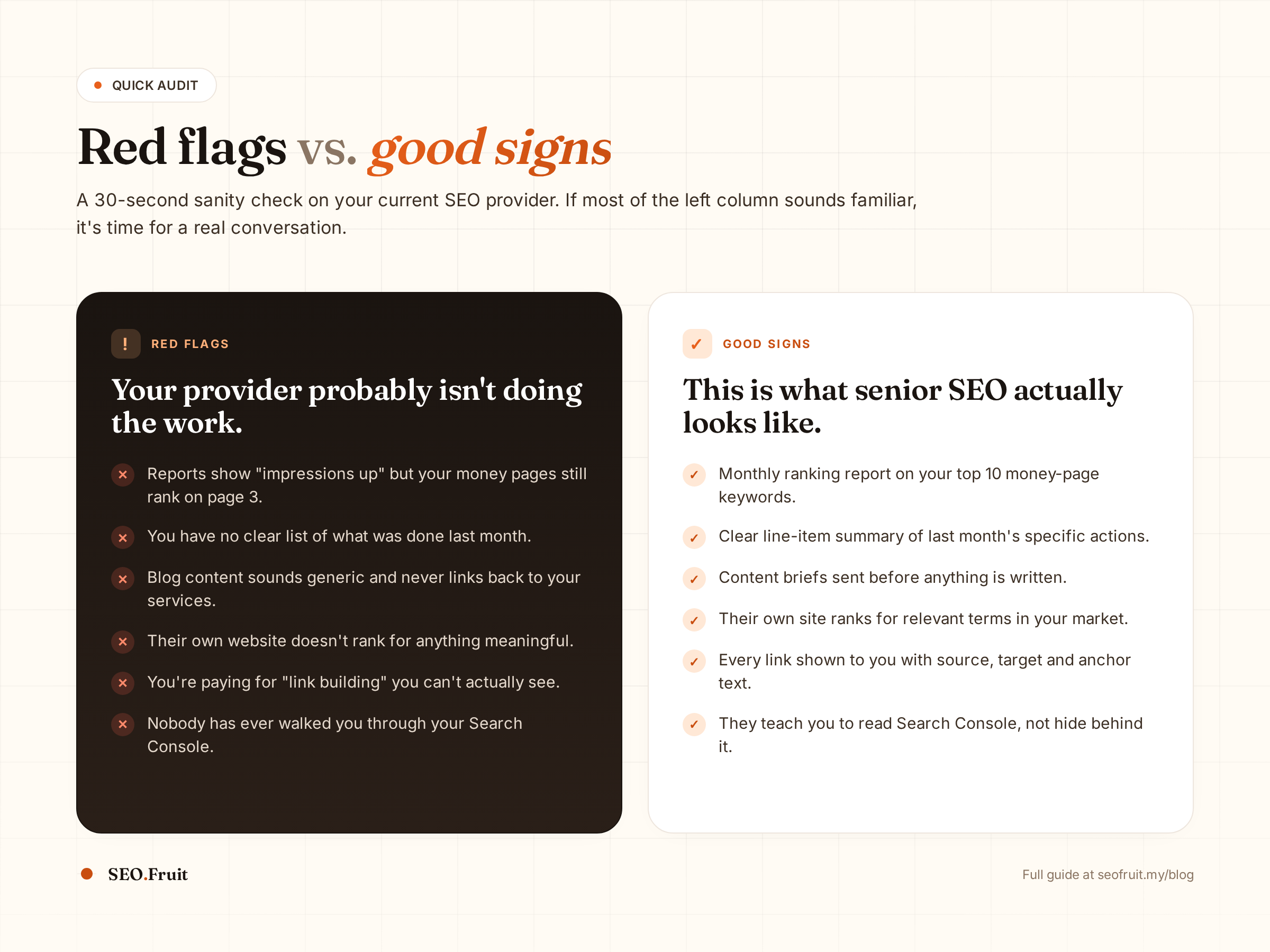
Red flags vs. good signs, at a glance
Before the checklist, here is the same picture in one frame. If most of the left column sounds familiar, it is time for a real conversation with your provider, or with someone else.
A simple checklist before your next invoice
If you are not sure where to start, use this as a once-a-quarter audit. Ten minutes, and you will know whether to keep paying.
- Can they show you a specific list of actions taken last month?
- Are your money-page rankings actually moving over three to six months?
- Do you personally have access to your Google Search Console?
- Does the content they produce sound like your business and link to your money pages?
- Can you see every link they claim to have built, on real sites?
- When you ask what they would do differently starting today, do they answer specifically?
If you can say yes to at least five of these, your provider is probably doing real work.
If you cannot, it is time for a harder conversation.
A final note
SEO is not magic. Good SEO is boring, consistent, measurable, and honest. It should give you rankings you can verify, content you would be proud to put your name on, and a clear paper trail of what was done.
If what you are getting does not look like that, it is worth asking why, and it is worth getting a second opinion before you sign another twelve-month commitment.
Related reading
The natural follow-up question, once you have worked out whether your current provider is doing real work, is whether you are paying a fair price for it. I wrote a full breakdown in the same operator voice: SEO pricing in Malaysia: what you will actually pay in 2026 (and what you are really buying). Five honest tiers from under RM500 to RM6,000 and above, what each one really buys you, and where the money quietly leaks in most Malaysian retainers.
Get a second opinion
If you want that second opinion, I audit up to two Malaysian SME sites a month for free. No sales pitch at the end, just the findings. Send your URL through the contact form and you will get my reply within two working days. If it is useful, we can talk about whether working together makes sense. If not, you still walk away with a clear picture of what to fix.